Showing posts with label Michigan. Show all posts

Lawyers & Scientists Are Building A Case For Why Natural Immunity Should Be Treated Same As Vaccination

natural immunity logo


Now that at least one employer in the healthcare field - Michigan's Spectrum Health - has decided to accept proof of natural immunity from prior infection as a reason to waive its vaccination mandate for all employees, legal experts (and the reporters who love to quote them) are wondering: will the legality of proving natural immunity potentially win out in court?

The answer to that question, they say, will depend - as all things COVID-related do - on "the science", that nebulous and frequently shifting concept of how prior infection impacts immunity to new variants (and whether vaccine's do as well).

According to a report in Yahoo Finance, the notion that natural immunity is superior is already gaining support in the legal world. Presently, a handful of studies from different countries offer a conflicting view of whether natural immunity actually is superior to vaccinated immunity, or a combination of prior infection and vaccination

Since it's likely the federal government's aim to roll out vaccine mandates that cover practically every US worker (they're not too far off already), the issue of natural vs. vaccine immunity and whether some individuals should receive exemptions based on their antibody levels almost certainly be adjudicated in the federal courts.

At least one attorney quoted by Yahoo agrees:

"I think that a judge might reject a rule that's been issued by a body, like the U.S. Department of Labor or by a state, that has not been sufficiently thought through as it relates to the science," Erik Eisenmann, a labor and employment attorney with Husch Blackwell, told Yahoo Finance.

As we reported when it was first published, a report out of Israel suggests that natural immunity could be many times more effective than the Pfizer vaccine at preventing infection with the delta variant. That study has yet to be peer-reviewed, however, and the world is anxiously awaiting the results.

However, another peer-reviewed study cited by the CDC looks at dozens of cases in the US where certain people who tested positive for COVID never ended up generating the antibodies, which, science dictates, are necessary to fend off future infection.

The CDC also published a study of 246 Kentucky residents, concluding that vaccination offers higher protection than a previous COVID infection. The CDC said the study went through a "rigorous multi-level clearance process" before submission, but now some are concerned it's slightly out of date since it pre-dates the rise of delta.

But as far as supporting natural vs. vaccinated immunity goes, this study is another big one: A C A June study by the Cleveland Clinic and Washington University tracked 52,238 Cleveland Clinic employees found that within 1,359 previously infected and unvaccinated people, none contracted a subsequent COVID-19 infection over the five-month study. The findings led authors to conclude that prior infection makes a person "unlikely to benefit from COVID-19 vaccination."

Then there's this:

In a smaller study conducted by Washington University School of Medicine and published in Nature, senior author Ali Ellebedy, Ph.D., an associate professor of medicine and of molecular microbiology, found antibody-producing cells in the bone marrow of 15 of 19 study subjects 11 months after their first COVID-19 symptoms. "These cells will live and produce antibodies for the rest of people’s lives. That’s strong evidence for long-lasting immunity,” Ellebedy said.

The legal and scientific standards are intertwined here, but as more data develops that appears to validate the argument that natural immunity is at least as effective as vaccinated immunity, it's more likely that lawyers will succeed in convincing judges that the standard should be "immunity by any means."

Read about T-Cells

Full story and comments

Lawsuits Filed Against Michigan Universities over Vaccine Mandates

Lawsuits Filed Against Michigan Universities over Vaccine Mandates

Western Michigan and Michigan State are getting sued and not permitting religious exemptions nor are they allowing these individuals who filed a class-action lawsuit to participate in sports.  They are claiming they have the antibodies and immunity from prior infection and do not want to take the vaccine.  

Michigan State University Lawsuit


Worldwide Pro Choice Protests Against Vaccine Mandates & Passes

150,000+ people across France protested against a bill requiring everyone to have a special virus pass to enter restaurants and mandating COVID-19 vaccinations for all health care workers. Police fired water cannons and tear gas on rowdy protesters in Paris.
Thousands of people demonstrated in Athens, Greece and other Greek cities over plans to make COVID-19 vaccinations mandatory for all health workers. Hundreds of people marched in Cape Town, South Africa to protest against the COVID-19 vaccines. They say they want their constitutional right to freedom of association respected. They have decried, what they say is information censorship against voices that do not accept the dominant narrative on COVID-19 and vaccines. "We say 'No to the Green Pass' because it creates A series citizens and B series citizens. Citizens who have rights and citizens who have no rights. This is against the Italian Constitution. It is a liberticidal and undemocratic measure," one protester argued in Italy. Biden’s motorcade is met with jeers and middle fingers at his visit to Allentown, PA Thousands of protesters took to streets in Sydney, Australia demanding an end to lockdown enforcement. Protesters violated Covid restrictions, chanting slogans of ‘freedom’ in an area that was declared a Covid hotspot. While anti-vaccination sentiments were at the forefront in Brisbane, Melbourne protests echoed with anti-lockdown slogans.Protest against Trinity Health vaccine mandate in Grand Rapids, Michigan Hundreds of hospital workers showed up at the state Capitol on Wednesday to protest two of the largest health care providers in Arizona mandating getting vaccinated.California’s Capitol was buzzing Monday with people protesting a bill that would make it harder to get a medical exemption for vaccinating their children. Every year, tens of thousands of Americans get sick from diseases that could be prevented by vaccines – some people are hospitalized, some even die. Immunization is our best protection against these diseases.

Locked-Down States Are Where COVID Is Growing Most

COVID cases April 20, 2021

The response from the corporate media and the Left was predictable. California Governor Gavin Newsom declared the move “absolutely reckless.” Beto O’Rourke called the GOP a “cult of death.” Joe Biden called the move “Neanderthal thinking.” Keith Olbermann insisted, “Texas has decided to join the side of the virus” and suggested Texans shouldn’t be allowed to take the covid vaccine. Vanity Fair ran an article with the title “Republican Governors Celebrate COVID Anniversary with Bold Plan to Kill Another 500,000 Americans.” 

Other states have followed in Texas’s wake, and Mississippi, Alabama, Florida, and Georgia are now all states where covid restrictions range from weak to nonexistent.

Georgia and Florida, of course, are both notable for ending lockdowns and restriction much earlier than many other states. And in those cases as well, the state governments were criticized for their policies, which were said to be reckless and sure to lead to unprecedented death. Georgia’s policy was denounced as an experiment in “human sacrifice.”

Yet in recent weeks, these predictions about Texas’s fate have proven to be spectacularly wrong. Moreover, many of the states with the worst growth in covid cases—and the worst track records in overall death counts—have been states that have had some of the harshest lockdowns. The failure of the lockdown narrative in this case has been so overwhelming that last week, when asked about the Texas situation, Anthony Fauci could only suggest a few unconvincing lines about how maybe Texans are voluntarily wearing masks and locking down more strenuously than people in other states. In Fauci's weak-sauce explanation we see a narrative that simply fails to explain the actual facts of the matter. 

Texas vs. Michigan

The Texas situation is just one piece of a state-by-state picture that is devastating for the lockdowns-save-lives narrative.

For example, let’s look at covid case numbers as of April 20.

Case numbers are a favorite metric for advocates of stay-at-home orders, business closures, mask mandates, and repressive measures in the name of disease control.

In Texas, the total new cases (seven-day moving average) on April 20 was 3,004. That comes out to approximately 103 per million.

Now, let’s look at Michigan, where a variety of strict mask mandates and partial lockdowns continue. Restaurant capacity remains at 50 percent, and the state continues to issue edicts about how many people one is allowed to have over for dinner.

In Michigan, the seven-day moving average for new infections as of April 20 was 790 per million - nearly eight times worse than Texas.

Last week, Anthony Fauci, head of the US National Institute of Allergy and Infectious Diseases (NIAID) struggled to come up with an explanation as he testified to Congress.

In previous weeks, Fauci tended to rely on the old tried-and-true claim that if we only wait two to four more weeks, cases will explode wherever covid restrictions are lessened or eliminated. Lockdown advocates tried this for months after Georgia ended its stay-at-home order, although Georgia consistently performed better than many states that continued their lockdowns.

But now that we’re six weeks out from the end of Texas’s mask mandate and partial lockdowns, Fauci could offer no plausible explanation. Rather, when pressed on the matter by Representative Jim Jordan, Fauci insisted that what really matters is compliance rather than the existence of mask mandates and lockdown mandates:

There’s a difference between lockdown and the people obeying the lockdown…. You know you could have a situation where they say, "We’re going to lock down," and yet you have people doing exactly what they want—

Jordan asked if this explains the situation in Michigan and New Jersey (and other states with quickly growing covid case rates). Fauci then claimed he couldn’t hear the question, and Jordan was cut off by the committee chairman.

No one who is familiar with the situation in states like Texas, Florida, and Georgia, however, would find it plausible that the spread of covid has been lessened in those areas by more militant use of masks and social distancing. Fauci's testimony was clearly just a case of a government “expert” grasping about for an explanation.

But don’t expect Fauci and his supporters to give up on insisting that New York and Michigan are doing "the right thing" while Texas and Florida are embracing "human sacrifice" as a part of a "death cult." 

The actual numbers paint a very different picture, and even casual observers can now see that the old narrative was very, very wrong.


Electoral College Projections Amid Pending Recounts & Legal Challenges

Wisconsin  

  • Top Election Official Says ‘No Evidence’ of ‘Systemic or Widespread’ Issues 
  • Elections Panel Guidance Led Clerks to Fill Out Witness Addresses, Contrary to State Law

Michigan: 

  • Trump Campaign Announces 2nd Lawsuit in Michigan
  • Trump Lawsuit Alleges Rampant Violations at Detroit Vote Counting Center
Pennsylvania

  • Kayleigh McEnany: Trump in ‘Great Spirits,’ Lawsuits Likely Will Make It to the Supreme Court
  • Trump Campaign: Pennsylvania Lawsuit Will ‘Prevail’
Georgia

  • Trump Campaign: Georgia Recount Step in ‘Methodical’ Path to Reelection
  • Trump Campaign Says There Is Evidence That Dead People Voted in Georgia
Nevada

  • Trump Campaign Dismisses Its Appeal to Nevada Supreme Court
  • Nevada Secretary of State Issues Statement on Voter Fraud Allegations
Arizona

  • Arizona Congresswoman Says Trump Should Not Concede
  • Trump Gains on Biden in Arizona in Latest Ballot Count

Rudy Giuliani's Greatest Corruption Speech Ever!

"MASSIVE FRAUD" Rudy Giuliani Says Major LAWSUITS Will Be Happening

Trump's Lead of 8% in Michigan Vanishes Overnight?

Michigan Voting Fraud Map
Wisconsin Election Fraud Map
Michigan voter fraud map
Mail-in voter fraud in Michigan seems to be happening.   
Ballot dumps behind the lead change?
How much of this was voter fraud?

Trump’s Lead of 8% in Michigan Vanishes Overnight? What Really Happened

On election night in November 2020, millions of Americans watched as Donald Trump held a strong lead in Michigan—reported by some as nearly 8 percent. But by the next morning, that lead was gone. Joe Biden had overtaken him, and Michigan was ultimately called in favor of Biden. For many, especially those watching in real time, this sudden shift raised questions: How does an 8% lead disappear overnight? Was this normal or was something else going on?

This article breaks down what happened, why it happened, and whether this “overnight flip” was unusual or expected.

Why Trump Led Early in Michigan

Michigan, like many states, reported votes in phases. The first votes to be counted were mostly in-person ballots cast on Election Day. These traditionally skew more Republican.

Key factors:

  • Election Day votes got counted first, and Trump dominated among those.

  • Mail-in and absentee ballots were counted later, and these strongly favored Biden.

  • Michigan law did not allow early processing of mail-in ballots before Election Day, which caused a large backlog that was only reported late at night and into the early morning hours.

Because of this, early numbers looked like a large Trump win. But those numbers did not include hundreds of thousands of mail-in ballots still waiting to be counted.

The “Blue Shift” Explained

What happened in Michigan wasn't unique—it’s part of a known phenomenon called the blue shift.

What it means:

  • Democrats were more likely to vote by mail in 2020 due to COVID-19 concerns.

  • Republicans were more likely to vote in person on Election Day.

  • When only in-person votes were counted early, it created a “red mirage.”

  • When mail-in votes were posted later, the totals shifted toward Biden—the “blue shift.”

This explains why Trump’s lead shrank, then disappeared as new vote batches were added overnight.

The 3 A.M. Vote Spike—What Was It?

A viral claim stated that “at 3:42 a.m., 138,000 votes were dumped in Michigan—all for Biden.” This was widely shared on sites like Coronafraud.com and social media.

Here’s what actually happened:

  • A clerical reporting error by a county clerk briefly showed an incorrect batch of votes.

  • The mistake was corrected within an hour.

  • The corrected data still showed Biden gaining, but not by 138,000 votes in a single drop.

  • Large late ballot updates came from Detroit and other urban counties, which heavily favored Biden.

Was There Fraud?

Multiple investigations, recounts, audits, and lawsuits were filed in Michigan. The results:

  • No court found evidence of widespread fraud.

  • The Republican-led Michigan Senate Oversight Committee concluded there was no basis for claims of vote flipping or voter fraud.

  • Trump’s own Attorney General, Bill Barr, stated the DOJ found no evidence of fraud that would change the election outcome.

While irregularities happen in every election, none were found that would overturn the results in Michigan. 

Lessons for Future Elections

The Michigan situation highlights key takeaways for all Americans:

  1. Election night numbers are not final numbers.

  2. How and when votes are counted can change the appearance of the race.

  3. Mail-in ballots, especially in urban areas, can drastically affect results once counted.

  4. Transparency and public understanding of the vote-counting process matter.

Final Thoughts

Did Trump really lose an 8% lead in Michigan overnight? Yes, the early lead disappeared—but not because of fraud or manipulation. It happened because different types of ballots were counted at different times, and the late ballots strongly favored Biden.

The “vanishing lead” was not a mystery. It was math, timing, and the mechanics of democracy during an unusual election year.

Did The News Stage "Fake Patients” In Coronavirus Testing Line in Grand Rapids, MI


Michigan Health Center Workers Stage “Fake Patients” In COVID19 Testing Line For News

CBS News Accused of Using Fake Footage in Coronavirus Testing Report

CBS denies faking scene of crowded Michigan testing clinic alleged in Project Veritas sting

TV network CBS News has been accused by right-wing activist group Project Veritas of using a staged shot to exaggerate how bad the coronavirus pandemic has hit Michigan. Footage of a long line of cars, apparently waiting to get coronavirus tests at Cherry Medical Center in Grand Rapids, was used in a CBS This Morning series on testing in Michigan, which accused the state’s health system of “fail[ing] some of its people.” However, Project Veritas said the CBS News crew got hospital staff to line up in their cars so it looked busier. The claim is based on an interview with an anonymous hospital “insider” who approached Project Veritas with information on the CBS shoot, and other hospital staff who are named in the clip but appear to have been filmed covertly by the “insider” discussing the staged shot.

In a statement to Project Veritas, CBS News accused Cherry Health of adding staff to the queue without their knowledge, and said the Cherry Health portion of the report would be removed. CBS This Morning admitted last month that they mistakenly used footage of an overflowing Italian hospital ward in a report on New York hospitals.

Here is the fake staging line below.


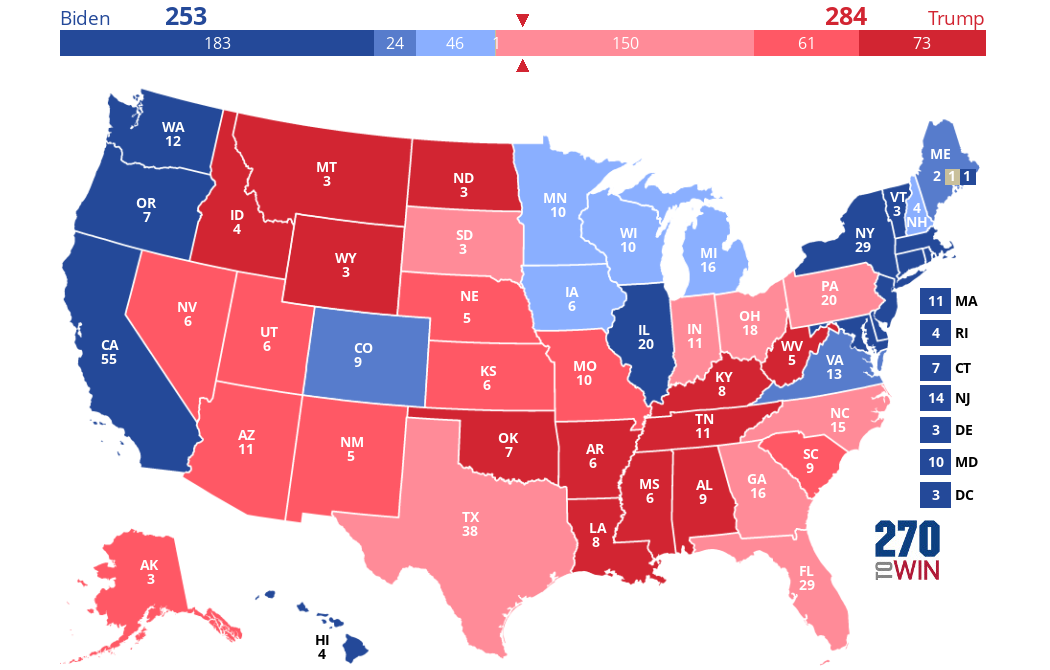
How Trump Wins With 284 Electoral College Votes to Biden's 253

Electoral College Forecast for 2020 Election

It will take 270 electoral votes to win the 2020 presidential election. Click states on this interactive map to create your own 2020 election forecast. Create a specific match-up by clicking the party and/or names near the electoral vote counter. Use the buttons below the map to share your forecast or embed it into a web page.

Trump won the presidency in 2016 despite Clinton receiving almost 3m more votes, all because of the electoral college. How does the system work?  Were all of the votes legitimate?  Not likely with all the election voting fraud coming out recently.  

In 2016, Trump gained a quarter of his electoral votes from just 191,000 votes in the closest four states. 
Two of the last five elections were won without gaining the most votes.

popular vote margin vs electoral margin %
 “At the moment, the electoral college favors Republicans because of the way Republican voters are distributed across the country. They are more likely to occur in states that are closely divided between the parties.”

Under the winner-take-all system, the margin of victory in a state becomes irrelevant. In 2016, Clinton’s substantial margins in states such as California and New York failed to earn her enough electoral votes, while close races in the battleground states of Pennsylvania and Michigan took Trump over the 270 majority.

State-by-State Map of COVID School Buildings Closures

  1. No order (Yellow) - In-person instruction decisions are currently being made on a local level, with states only providing guidelines or recommendations.
  2. Full closure (Dark Red) - In-person instruction is not allowed.
  3. Ordered open (Blue) - In-person instruction must be available to all students, either full- or part-time.
  4. Partial closure (Light Red) – Full-time in-person instruction is either not allowed in certain regions of the state or is only available for certain age groups. Hybrid instruction may be allowed.

State Public School Enrollment Information on state orders or recommendations

Alabama 739,716 Districts will make the decision on whether to open school buildings. The state board of education encourages that all schools provide, at a minimum, access to both traditional and remote learning throughout the 2020-21 school year.

Alaska 130,963 Each school district will decide when and if to reopen buildings. The state departments of education and health created a framework and guidance to help districts as they decide how to provide instruction.

Arizona 1,141,511 School districts, in conjunction with their local health departments, must consider benchmarks on new cases, diagnostic test percent positivity, and COVID-19 related hospitalizations to determine when in-person classes can begin again. Starting Aug. 17, districts are required to provide “free on-site learning opportunities” and support services for students who need access to a computer or a supervised place to be during the day, even if the school system has opted for full-time distance learning.

Arkansas 495,291 Education Secretary Johnny Key issued guidance Aug. 5 that requires districts to offer in-person instruction five days a week when classes resume. Districts were required to open their schools as soon as Aug. 24 and as late as Aug. 26. Decisions on whether to close a school is being made in collaboration with the Arkansas departments of health and education.

California 6,272,734 Each local district will decide when to reopen, but in order to offer any face-to-face instruction, they must abide by metrics that Gov. Gavin Newsom unveiled on Aug. 28. According to the state’s new four-tiered framework, districts may allow students into school buildings only if their counties meet key local metrics on coronavirus spread for two weeks.

Colorado 911,536 Reopening plans are made locally. The reopening guidance for schools put out by the state recommends that districts have a variety of plans in place in addition to in-person classes, including teaching students in small groups and through distance learning.

Connecticut 526,634 Districts were asked to plan for all students to return to school for full-time, in-person instruction this fall as long as public health conditions support face-to-face teaching.

Delaware 138,405 On Sept. 3, Gov. John Carney formally extended Delaware’s state of emergency for another 30 days, restricting in-person gatherings. Schools have started to reopen with a mix of in-person and remote instruction, based on “minimal to moderate” viral spread among communities. The state provides free COVID-19 testing for school staff and students, but health officials said the state could not require staff to be tested before returning to school. The state also released guidance for low-, medium-, and high-risk youth sports programs, requiring both facial masks and physical distancing.

District of Columbia 93,741 The District of Columbia Public Schools will continue with distance learning for at least the first term of the 2020-21 school year, from Aug. 31 through Nov. 6, Mayor Muriel Bowser announced.

Florida 2,846,444 A state court judge on Aug. 24 issued a temporary injunction blocking a state emergency order requiring all brick-and-mortar schools to open at least five days a week by Aug. 31. However, a Florida state appeals court on Aug. 28 issued a stay of the trial court judge’s injunction, putting the state’s emergency order back in place. The appellate court is considering an expedited appeal on the merits of the dispute.

Georgia 1,767,202 Districts will decide whether to open school buildings, open them on a limited basis as part of a staggered schedule, or use an all-remote schedule. Those decisions should be informed by whether students and/or staff have been directly exposed to or diagnosed with COVID-19.

Hawaii 181,278 As a statewide district, Hawaii schools reopened on Aug. 17. In some areas, schools may offer a blend of in-person and remote learning, but in others, due to rising coronavirus rates, they are allowed to teach only remotely.

Idaho 310,522 Schools were expected to welcome students for in-person instruction this fall while adhering to public health guidelines and maintaining options for blended learning for students who don't return and in case of a return to full-time remote learning. On Oct. 4, a White House Coronavirus Task Force report said that school openings may be the cause of rising coronavirus cases in a number of Idaho counties and recommended that schools in these counties move to a remote-only learning model. The Center for Public Integrity reported that this "appears to be the first time the task force has explicitly recommended closing schools".

Illinois 1,982,327 Districts can decide whether to open school buildings, following health and safety guidance from the state. However, the Illinois State Board of Education has "strongly encouraged" a return to full, in-person instruction in the fall, as long as the regions are in Phase 4 of reopening.

Indiana 1,055,706 Districts set their own academic calendars and can make individual decisions about when or if students return to in-person classes. State health officials have created a color-coded map that indicates the level of community spread in each county, which Health Commissioner Kristina Box has said schools should use as guidance when making decisions about in-person instruction.

Iowa 514,833 On July 17, Gov. Reynolds, overriding local decisions, ordered every student to spend at least half of their schooling inside classrooms. Districts must also provide online classes for parents who demand it. Temporary/continuous remote learning for an entire school or district can only be requested if the COVID-19 positivity rate averages 15 percent to 20 percent countywide over the past 14 days, and 10 percent absenteeism is expected for in-person instruction.

Kansas 497,733 The Kansas Board of Education voted July 22 to reject an order by Gov. Laura Kelly that would have delayed the start of school until Sept. 8. The vote put the decision on when to reopen back in the hands of local school districts.

Kentucky 677,821 Gov. Andy Beshear has recommended that schools should not begin in-person classes before Sept. 28. State officials have created a color-coded framework that they recommend schools use to make decisions about in-person instruction based on community spread.

Louisiana 711,783 While school districts can choose when to reopen, the state's board of education has dictated a series of standards districts must meet before they reopen.

Maine 180,461 The state has approved all schools to offer in-person instruction this fall with required health and safety measures, but individual districts will make their own decisions.

Maryland 896,827 The state allows districts to make plans for in-person classes, as long as they follow state and federal health recommendations.

Massachusetts 962,297 Each school district and all but two charter schools have submitted their return-to-school plans to the state education department; approximately 70 percent of school systems are opting for either in-person or hybrid learning.

Michigan 1,504,194 Gov. Gretchen Whitmer said in-person learning can only occur in a region that's in at least phase four of her reopening plan. The state legislature passed a measure that says districts must reconfirm their plans on how to deliver instruction every 30 days. Districts that reopen for in-person instruction must prioritize K-5 students.

Minnesota 889,304 Districts can determine whether to start the school year remotely, fully in-person, or in a hybrid model based on the number of new coronavirus cases in their county. The state developed suggested thresholds for when school buildings can reopen, and districts can adjust their learning models throughout the school year if needed.

Mississippi 471,298 Districts may choose to open school buildings, but they must modify schedules, restrict gatherings, and observe social distancing in accordance with state and federal recommendations.

Missouri 913,441 Districts were required to open by Aug. 24 but could receive a waiver from the state's department of education to open later.

Montana 148,844 The state department of education issued July guidance on four possible reopening scenarios, including for "near full capacity of attendance and operations in a traditional setting, with remote learning for students not onsite." Under this scenario, there is no limit on group sizes in schools, but social distancing should be observed, and monitoring for symptoms of COVID-19 should still take place, the guidance says.

Nebraska 326,392 Nebraska Gov. Pete Ricketts has given districts discretion to set their own reopening plans using guidance from the state’s education department. That guidance advises remote or hybrid learning plans in communities with the significant or moderate spread.

Nevada 498,614 Guidance from the Nevada education department says school districts and charters must develop distance learning plans "even if a district/school has sufficient space to open for full-time in-person instruction" under the second phase of the state's reopening guidelines. However, schools must also develop plans that cover in-person learning, under a directive from Gov. Steve Sisolak.

New Hampshire 178,515 Local districts will decide whether they open for full-time, in-person teaching, continue with remote instruction, or employ a combination of the two as part of hybrid models.

New Jersey 1,400,069 Districts develop their own reopening plans that must meet core health and safety standards in the state’s school-reopening guidance. While state guidance released June 26 prioritized a return to in-person classes, on Aug. 12, Gov. Phil Murphy announced an executive order that schools could open as remote-only if they cannot meet health and safety standards for live instruction. However, districts must lay out how they intend to address the health and safety challenges to move to in-person instruction.

New Mexico 333,537 School buildings serving grades K-5 and K-6 can open under a hybrid schedule so long as they are in counties that have demonstrated low enough rates of COVID-19 spread and the New Mexico Public Education Department has approved the school's reopening plans.

New York 2,700,833 School districts across the state can reopen in-person in the fall, though that may be revised on a regional basis if COVID-19 infection rates increase. School systems will have to follow state guidelines, but the specifics of the plans--including whether teaching will be delivered in-person or via a hybrid model-- will be up to the districts.

North Carolina 1,552,497 Starting Oct. 5, districts will be able to open their elementary schools to full-time instruction if they choose Gov. Roy Cooper announced Sept. 17. The districts that do so must still require mask-wearing, symptom screening, and social distancing, but elementary schools will not be required to reduce the number of children in classrooms. For now, middle and high schools must still operate on either a hybrid or fully-remote schedule, and districts must still offer a fully-remote option for elementary families who want it.

North Dakota 113,845 Gov. Doug Burgum said July 14 that school districts could reopen for in-person instruction in consultation with local health officials.

Ohio 1,695,762 Districts will decide whether to open school buildings, but the state department of education has said that they should only do so if they can follow the state's health and safety guidance. All students attending school in person will be required to wear masks, with some medical exemptions.

Oklahoma 698,891 The state has advised districts in its reopening guidance to prepare alternate school calendars for potential school closures. Individual school districts will determine when to start school this fall.

Oregon 609,507 The state department of education outlines state and county COVID-19 metrics that determine whether districts can open buildings part-time, full-time, or not at all. Schools in areas that have seen three weeks of positivity rates and COVID-19 caseloads below public health benchmarks can begin reopening for in-person instruction. Schools in areas that don't meet those benchmarks are barred from reopening buildings unless they receive allowances from the state. As of Sept. 10, 17 of the state's 36 districts are permitted to at least partially reopen school buildings.

Pennsylvania 1,730,757 State guidance allows school districts to decide whether they will use in-person or remote instruction or a mix of both.

Puerto Rico 307,282 On Sept. 14, a new executive order from Gov. Wanda Vázquez Garced required public school educators to continue with distance learning until further notice, according to an advisory from Secretary of Education Eligio Hernández Pérez.

Rhode Island 143,436 Most schools have resumed classes. Districts that began the school year with hybrid or remote learning plans have until Oct. 13 to resume full in-person instruction.

South Carolina 780,882 State Superintendent Molly Spearman sent a letter to the district leaders Sept. 16 urging them to prioritize a return to traditional face-to-face education "for students who need it the most," including elementary students, students with disabilities, English-language learners, and children with poor Internet service. Reported high rates of COVID-19 spread in some counties should not be used to make all operational decisions, Spearman said. At the time of her letter, most school districts in the state were engaged in hybrid or fully-remote learning.

South Dakota 138,975 South Dakota's state education department issued guidance that gives discretion to local districts to set restart plans in consultation with local health officials. It recommends flexible plans that prioritize face-to-face instruction.

Tennessee 1,007,624 Districts will decide whether to open school buildings. The state department of education's guidance also provides a framework that districts can use to assess risk and decide when it would be safe to reopen.

Texas 5,433,471 Texas requires school districts to provide daily, on-campus learning for any family who wants it in order to not lose state funding due to declines in enrollment.

Utah 677,031 The Utah state board of education released a set of minimum requirements for local school districts to meet before reopening schools for in-person instruction. Districts created plans for resuming in-person learning that addresses schedules, hygiene, and safety, monitoring schools, "containing potential outbreaks" and (if necessary) temporarily closing schools again, among other areas.

Vermont 87,359 Schools reopened across the state on Sept. 8, with districts offering in-person, hybrid, and all-remote options for students. The state’s education agency and the health department had recommended full-time in-person learning “as soon as practical,” especially for students in Pre-K through Grade 5. However, local districts currently make the decision on how to reopen.

Virginia 1,289,367 Schools across the state are open in various forms, depending on public health conditions. As of Sept. 22, 68 of the state’s 132 school districts are operating in fully remote learning mode.

Washington 1,123,736 State officials announced Aug. 6 that they recommend schools in areas with high rates of new COVID-19 cases reopen with full-time distance learning for nearly all students. Schools in areas with moderate rates of virus transmission should consider opening buildings only for elementary students, officials said, and districts in areas with low transmission should begin hybrid instruction for middle and high school students. The state's education department earlier this summer urged all schools to reopen for some in-person learning, but the persistence of new COVID-19 cases forced a more cautious set of recommendations for local decisions, Gov. Jay Inslee said.

West Virginia 267,976 Each Saturday, the West Virginia Department of Health and Human Resources evaluates COVID-19 transmission rates to determine the instructional options allowed in each county. Currently, some regions of the state are not allowed to open for in-person instruction.

Wisconsin 859,333 Districts decided whether to offer full in-person instruction, stick to remote learning, or go with a hybrid model. The Wisconsin Department of Public Instruction has provided guidance as districts develop their plans based on infection rates in their area.

Wyoming 94,313 The state's department of education asked each district to send a detailed plan on how they will reopen their schools.

See data source

Nursing Home Residents Account for 40% of COVID-19 Deaths in U.S.

Nursing home residents have accounted for 35-40 percent of all COVID-19 deaths in the US since the coronavirus pandemic started. That's a big number, given that just 0.45 percent of the entire U.S. population is made up of 1.5 million people living in nursing homes.

What states have seen the most nursing home deaths from coronavirus? We rated all 50 using data obtained from the COVID-19 Public File of the Nursing Home, which includes data recorded to the National Healthcare Safety Network of the CDC. This information shares information on the facility capacity of the nursing homes, resident effects, the number of supplies and protective equipment, as well as their ventilator capacity. With coronavirus nursing home fatality rates of more than 100 deaths per 1,000 nursing home residents, four states in the Northeast were at the top of the list.

For every 1,000 nursing home patients, Massachusetts was the state with the highest coronavirus nursing home fatality rate, with 124 deaths. It was also found that the state of Massachusetts had one of the highest rates of infection with coronavirus in nursing homes, with 337.4 cases per 1,000 people. 

New Jersey nursing homes have found themselves a near second because of their high coronavirus mortality rate, 122.6 per 1,000 residents. New Jersey was also found to have the highest rate of COVID-19 cases by state in the world, with 359.2 people testing positive for every 1,000 residents in the nursing home.

The U.S. States Ranked by Their Coronavirus Nursing Home Fatality Rate per 1,000 Nursing Home Residents
  1. Massachusetts: 124.0
  2. New Jersey: 122.6
  3. Connecticut: 102.5
  4. Rhode Island: 102.0
  5. Louisiana: 66.8
  6. Pennsylvania: 60.9
  7. Delaware: 57.5
  8. Maryland: 55.9
  9. Illinois: 52.6
  10. New York: 48.5
  11. Michigan: 47.2
  12. Indiana: 46.7
  13. Arizona: 42.6
  14. Mississippi: 42.4
  15. New Hampshire: 40.2
  16. Georgia: 39.6
  17. Alabama: 36.9
  18. South Carolina: 34.9
  19. California: 33.8
  20. Florida: 30.1
  21. Colorado: 29.8
  22. New Mexico: 29.3
  23. Virginia: 27.1
  24. Washington: 27.0
  25. Nevada: 25.9
  26. Ohio: 25.2
  27. Texas: 25.0
  28. Kentucky: 23.5
  29. North Carolina: 22.7
  30. Minnesota: 20.1
  31. Iowa: 19.1
  32. Nebraska: 16.9
  33. Arkansas: 15.7
  34. Idaho: 15.3
  35. Utah: 14.6
  36. Montana: 13.8
  37. Vermont: 11.3
  38. Oklahoma: 10.8
  39. Kansas: 10.1
  40. Wisconsin:10.1
  41. Tennessee: 7.3
  42. Maine: 7.2
  43. West Virginia: 5.9
  44. North Dakota: 5.6
  45. South Dakota: 4.7
  46. Oregon: 2.9
  47. Montana: 1.5
  48. Wyoming: 1.5
  49. Hawaii: 0.3
  50. Alaska: 0.0

Map of States Where Masks Are Required in Public

Map of States Where Masks Are Required Outdoors

Arkansas

As of July 20:
Gov. Asa Hutchinson announced that beginning on Monday, July 20, residents 10 years and older must wear masks when in the presence of non-household members and aren't able to socially distance. The order is enforceable and offenders can be cited for a misdemeanor or fined.
As of June 18:
Gov. Gavin Newsom issued a statewide order requiring the use of face coverings in public indoor spaces, including while shopping, riding on public transportation, or seeking medical care.
Newsom's order also mandated the use of masks or face coverings in public outdoor spaces when social distancing is not an option. There was no guidance on how the order will be enforced or if violators will face any penalties or citations.

Colorado

As of July 17:
Gov. Jared Polis announced that residents will be required to wear masks when in public indoor spaces and not able to socially distance from others.

Connecticut

As of April 20:
Connecticut's mask requirement applies to any resident over the age of 2 in a public space where social distancing isn't possible. The rules also apply to individuals using public transportation, taxis or rideshare services.
The state's Department of Economic and Community Development also released mask guidelines for essential workers:
Employees at essential businesses must wear masks or any other material covering their mouth and nose at all times while at work. Employers must provide masks or the materials to make them. All customers under age 2 must wear them, too.
On August 14, Lieutenant Gov. Susan Bysiewicz signed an executive order that requires residents to provide a doctor's note that shows they are exempt from wearing a mask due to a medical condition.

Delaware

As of April 28:
Gov. John Carney ordered residents to wear face masks while in public, including at grocery and convenience stores, pharmacies, doctor's offices, and on public transportation.
Children under the age of 12 are not required to wear face coverings, and those aged 2 and under must not wear face masks due to the risk of suffocation.

District of Columbia

As of May 16:
Mayor Muriel Bowser ordered the use of masks or face coverings when conducting essential business or travel and social distancing isn't possible.
Masks or other face coverings are required in grocery stores, pharmacies and takeout restaurants. On public transportation, face coverings are required if individuals are unable to be six feet apart.
Children between the ages of 2 and 9 are advised to wear masks.

Hawaii

As of April 20:
Both customers and employees at essential businesses are required to wear cloth face coverings. Establishments must limit the number of customers allowed in and keep them six feet apart.
Anyone who violates those rules could face a fine of up to $5,000, or up to a year in prison if found guilty, according to Hawaii Gov. David Ige's order.

Illinois

As of May 1:
    Gov. J.B. Pritzker ordered the use of face masks for anyone stepping outside their house.
    Face coverings are required while shopping at essential businesses, traveling on public transportation, picking up food, or visiting the doctor and it's impossible to stay six feet apart.

    Indiana

    As of July 27:
    Gov. Eric Holcomb announced that a statewide mask mandate will go into effect on July 27 due to the increase in the state's positivity rate and some counties seeing increases in cases.
    The mask mandate applies to anyone who is 8 years and older, and is required in indoor public spaces, commercial entities, while using transportation services and outdoors where social distancing isn't possible.
    The mask mandate will remain in effect indefinitely.

    Kansas

    As of July 3:
    An executive order was issued by Gov. Laura Kelly mandating face masks must be worn statewide in public spaces.

    Kentucky

    As of May 11:
    Gov. Andy Beshear ordered all state residents to wear face masks in public.
    Beshear has said that people will not be fined or arrested for not wearing a mask in public, but the order gives businesses the right to turn away any customer not wearing a face covering.

    Louisiana

    As of July 13:
    Gov. John Bel Edwards announced a statewide mask order for everyone 8 years and older.
    Parishes in the state can opt-out of the mask mandate if they don't have a high positivity rate, but Edwards said only three would qualify to do so right now.

    Maine

    As of May 1:
    Gov. Janet Mills issued an order requiring face coverings or masks for anyone over the age of 2 in indoor public spaces such as supermarkets, retail stores, pharmacies, and doctor's offices.

    Maryland

    As of April 18:
    Commuters must wear face coverings while using Maryland's public transit, according to Gov. Larry Hogan's order.
    Employees of essential businesses and customers over the age of 9 must wear face coverings. Adults accompanying young children should make an effort to get them to wear a mask.

    Massachusetts

    As of May 6:
    Governor Charlie Baker issued an order requiring the use of face coverings or masks in both indoor and outdoor spaces where social distancing isn't possible.
    Children under the age of 2 do not have to adhere to this order.

    Michigan

    As of June 18:
    Michigan requires all residents to wear face coverings or masks in all public settings.
    Businesses are allowed to deny entry to individuals not wearing face coverings.

    Minnesota

    As of July 25:
    Gov. Tim Walz has issued an executive order that requires the use of masks in indoor public places while using public transportation and while outdoors where social distancing isn't possible. Children under the age of 5 are exempt from the mask mandate.

    Montana

    As of July 16:
    Face coverings are now required in certain indoor business settings for counties with four or more active Covid-19 cases, according to a new directive issued by Montana Gov. Steve Bullock (D). Residents attending outdoor gatherings of 50 or more people when social distancing isn't possible will also require face coverings.

    Nevada

    As of June 24:
    Nevada requires anyone in any public space to wear a mask. Nevada Gov. Steve Sisolak's office said this includes while using public transportation, in public-facing work environments, while patronizing businesses, or interacting with others in any generally publicly accessible space.
    "For Nevada to stay safe and stay open, we must make face coverings a routine part of our daily life," Sisolak said.

    New Hampshire

    As of August 11:
    New Hampshire Gov. Chris Sununu issued an order requiring masks to be worn at gatherings of more than 100 people. New Hampshire is the only New England state that does not have a statewide mask mandate in public where social distancing cannot be maintained.

    New Jersey

    As of April 8:
    New Jersey was the first state to require customers and employees to wear face coverings at essential businesses and construction sites. Businesses must provide them to employees and deny entry to any customer who refuses to wear them (though customers can still pick up food or medicines in other contact-free ways).
    Commuters on New Jersey's trains, buses, and light rails must wear face coverings. If they refuse, they may be denied entry.

    New Mexico

    As of May 16:
    Adults are required to wear masks in all public settings, except while eating, drinking, exercising, or for medical reasons. Masks are recommended for children 3 and older, and children 5 and under must have adult supervision.

    New York

    As of April 17:
    Gov. Andrew Cuomo's executive order mandated state residents to wear masks in public.
    All residents over age 2 must wear masks or face coverings when in public and social distancing is impossible.

    North Carolina

    As of June 26:
    Gov. Roy Cooper requires that face coverings be worn whenever people are out and about in public and where physical distancing is not possible. A number of businesses, such as restaurants and hair salons, also will require both employees and customers to wear face masks.
    "We need to all work together so we can protect our families and neighbors, restore our economy, and get people back to work and our children back to school," Cooper said in announcing the requirement.

    Ohio

    As of July 23:
    Gov. Mike DeWine announced during a news briefing that there will be a mask mandate that requires people to cover their nose and mouth when inside public spaces or outside when social distancing is not possible.

    Oregon

    As of July 1:
    Gov. Kate Brown has now required the state's residents to wear face coverings in all indoor public spaces beginning July 1. Face covering requirements are already mandated in eight counties but this would broaden the mandate to the whole state. 
    "I do not want to have to close down businesses again like other states are now doing," Brown said in a statement.
    "If you want your local shops and restaurants to stay open, then wear a face-covering when out in public," she added.

    Pennsylvania

    As of April 19:
    Essential businesses must provide and require their employees to wear masks, according to the order from Pennsylvania's Department of Health. Customers at these businesses must wear masks while on the premises or be denied entry.

    Puerto Rico

    People are required to wear face coverings when in public spaces. Businesses must ensure customers are wearing face coverings.

    Rhode Island

    As of May 8:
    Gov. Gina Raimondo issued an order requiring all residents over the age of 2 to wear face coverings or masks while in public settings, whether indoors or outdoors.

    Texas

    As of July 3:
    Gov. Greg Abbott issued an executive order that will require residents in counties with 20 or more active Covid-19 cases to wear face coverings in public. It takes effect midday on July 3.
    The order says that failure to comply could be punishable by a fine.

    Vermont

    As of August 1:
    Cloth face coverings are now required in public places -- both indoor and outdoor -- and in group living settings across the state anytime it's not possible to keep a 6-foot distance from other people who are not a part of your household.
    There are exemptions for people exercising outdoors, children under the age of two, anyone with a medical or developmental condition that is complicated by a face covering, and those with difficulty breathing.

    Virginia

    As of May 29:
    Gov. Ralph Northam instituted a statewide mask mandate that requires residents aged 10 and older to wear a mask when entering or spending time in establishments such as restaurants, grocery stores, and train stations.

    Washington

    As of June 26:
    Gov. Jay Inslee instituted a mask mandate that requires everyone to wear a mask or face covering in an indoor public space and in outdoor public spaces where social distancing isn't possible.

    West Virginia

    As of July 6:
    Gov. Jim Justice issued an executive order that he said would require all West Virginians 9 years old and up to wear a face mask anytime they are in public and indoors and where they are unable to maintain six feet of social distancing.
    Justice said he issued the order after the state experienced its highest daily total of new cases over the July 4th weekend.
    "I know it's an inconvenience, but it's not going to be much of an inconvenience," Justice said. "If you don't decide to wear the face-covering for yourself if you don't decide to wear it for one of your loved ones or your friends, do it for the 95 West Virginians that have died, do it for the 95 people that we've lost."

    Wisconsin

    As of August 1:
    Gov. Tony Evers issued a public health emergency and an emergency order that requires a face covering to be worn when indoors or in an enclosed space and not in a private residence, for residents who are 5 and older. The order is set to expire on September 28.

    Popular Posts (All Time)

    Topics

    5G Activist ADE Advertising Air Quality Airlines Alchohol Alex Berenson Allergic Angry Moms Antibody Antitrust Apple Apps Arizona Aspirin Astra Zeneca Australia Bankruptcy Banks Banned Bars BBB Beaches Bell's Palsy Ben Shapiro Biden Big Pharma Big Tech Bill Gates BioNTech BitChute Black Rock Blackmail Blood Clots Booster Brave Brownstone Institute Bryan Ardis Business California Canada Cancer Candace Owens Cares Act CDC Censorship Chart ChatGPT Chicago Children China Class Action Clinical Trials Closures CNN Comirnaty Conspiracy Contact Tracing Corruption Cough COVAX Cover Up Crimes Against Humanity Cult Cuomo Dan Bongino DARPA Data David Martin Deaths DeSantis Diabetes Died Suddenly Disinformation Doctor Reiner Doctors DOJ Dominion Dr Michael Yeadon Dr Reiner Dr Shiva Dr Zelenko Drugs Durability DWAC ECDC Education Election Elon Musk Email Enforcement Europe Exemptions Extortion Facebook Fact Checkers Fake Laws Fake News Fake Tests Fake Vaccine False Positive Famotidine Fauci FBI FDA Fear Mongering Federal Reserve Feds Fines Florida Flu Flu Shots Fluvoxamine Fox France Fraud Free Speech Freedom FTC Gain of Function Research Gavin Newsom Genome George Soros Germany Glenn Beck Globalism Google Government Guillain-Barré Halloween Harvard Health Health Department Healthcare Heart Herd Immunity Hero HHS Hospitals How To Humor Hydroxychloroquine Hypocrisy Immune System India Inflamation Injured Insurance Investment IRS Israel Italy Ivermectin J&J Japan Jeff Bezos Jim Jordan Jobs Joe Rogan Judy Mikovits LA County Larry Elder Lawsuits Leadership Let Them Breathe Lies Loans Local Laws Lockdown Long Covid Los Angeles Mandates Map Masks Mass Hypnosis Media Medicaid Melatonin Mental Health Michigan Microsoft Minnesota Moderna Money Montana mRNA Mutation Myocarditis Nanoscience Nashville Natural Immunity NBA New Jersey New Media New York Nextstrain NFL NIH Nursing Homes NY NY Post Ohio Omicron Omricon Opinion Opposing View Oppression Outdoors Parks Passport Patents PCR Pennsylvania Pericarditis Peter McCullough Pfizer Phishing Physicians Declaration Placebo Plandemic Pneumonia Police Politics Poll Pollution PPP Prevention Pro Choice Project Veritas Protest Racism Rand Paul Real Estate Refuse Regeneron Relief Checks Remdesirvir Restaurants Restraining Order Robert Kennedy Robert Malone Ron Johnson Rudy Giuliani Rumble Russia Safegraph SBA Scams Schools Science Scott Gottlieb Senate Seniors Side Effects Sinus Social Distancing South Korea Spain Sports Stadiums Stakeholder Capitalism Stay at Home Sterilization Steve Kirsch Study Substance Abuse Surveillance Sweden Swine Flu Symptoms T Cells Taxes Teachers Technology Teslaphoresis Testing Texas Tips Tom Cotton Tony Bobulinski Transmission Tribunals Trojan Horse Trump TruthSocial Tucker Carlson Twitter Tyranny UK Unemployment United Nations Unity Project Vaccine VAERS Video Vietnam Vitamin D War Warren Buffett Washington WEF Whistleblower WHO Wisconsin Women Workers Comp Wuhan Zinc